
|
|
1901 Census of
Norfolk Last updated: 08 Aug 2016 |
| Introduction | Source Documents | Photocopies | Comparison | Contributions | Back |
| A
B
C D E
F G H
I J K L
M Mc N O
P Q R
S T U
V W X
Y Z ? |
|
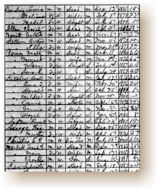
1901 Census of Norfolk County Canada's fourth national census, conducted in the spring of 1901, recorded the status of all residents as of 31 Mar 1901. This was the first time Canada's national census asked for specific date of birth, making it an extremely useful tool for genealogy researchers. The original handwritten census pages survive and have been microfilmed. Copies of these microfilms were released to the public domain in the early 1990s and today are available in many libraries and archives, and are available on inter-library loan for inspection. Many genealogy centres, such as the Norfolk Historical Society have transcribed and indexed subsets of this census and offer their printed transcriptions for sale at modest prices. (These transcripts typically transcribe only "key" data for those residing in a particular town or township.) The Government of Canada has also put the entire 1901 Census online at: Census of Canada, 1901. There is no charge to access that web site, so those prepared to do their own transcribing of an un-indexed, handwritten resource, organized only geographically, can have at it whenever they like. One word of warning, however: for most -- particularly those who do not know precisely where their ancestors resided -- reading microfilmed handwritten records of people you are not interested in can eat up a lot of time and energy. Think of it as looking for a needle in a haystack. In theory, a better solution can be found at Automated Genealogy, a web site that asks volunteers to transcribe and proof-read each page of microfilmed census. Transcriptions are much easier to read, online or off. Unfortunately, Automated Genealogy's transcriptions have not been surname indexed, so their transcriptions seem like another (albeit easier to navigate) haystack. The quality of Automated Genealogy's transcriptions varies with the skill of their volunteers, who too often don't seem to know the names they are transcribing the way local volunteers at the Norfolk Historical Society did. This is the value-added that local transcribers bring to the table. It is confusing enough when the census-taker got the name (and/or other data) wrong. Complicating that with iffy transcriptions can leave genealogy researchers scratching their heads. Hopefully, that's where we can help. Not for all of Canada mind you, just Norfolk County. In July 2008 we began to s-l-o-w-l-y review both districts of the 1901 census that collectively cover Norfolk County. Sub-district by sub-district (typically a town or township) we will be analyzing each line of each page, and posting subsets of our transcription of the microfilmed data to the B-M-D Etc. Armed with our indexed subsets of the data, genealogy researchers should find it much easier to find the same folks in the Automated Genealogy data subset, and from there review the source microfilm for themselves. All online, all for free, in just minutes. One small word of caution: the subsets you'll find here are not exact transcriptions of each entry. We have changed newborn ages from fractions of a year to the corresponding number of months. Wives, daughters, nieces, sisters, mothers and mothers-in-law are assumed to be female. Single women are sometimes titled "Miss." Sons, fathers, fathers-in-law, nephews and sons-in-law are assumed to be male. Questionable transcriptions appear in [square brackets], accurately recorded nonsense responses deemed questionable are followed by [sic]. A Jones residing in a Smith household is indexed twice: once under Smith and once under Jones. A Blume family was enumerated as Bloom. We recorded them as Bloom [sic] but filed the entry under Blume. A Winter family was enumerated as Winters. We recorded them as Winters [sic] but filed their entry under Winter. A Sebring family was enumerated as Sebering. We recorded them as Sebering [sic] but filed them under Sebring. Delhi's enumerator spelled every instance of Mabel "Mable." We recorded it as Mable [sic]. Sarah Heal, the enumerator for Windham:3, recorded middle initials as first initials. We corrected that, acknowledging doing so may have introduced errors. We chose the lesser of two evils to make our B-M-D Etc. Index as accurate as possible. Several abbreviations have been written out in full: S-in-L became son-in-law, canning f. hand became canning factory hand, or canning f[actory] hand. Which is why we recommend comparing our transcription to the scan of the hand-written original. The birth date provided in the 1901 Census does not always agree with the birth date provided on the same person's cemetery stone, obituary, death notice, or death registration. We recommend thoroughly checking the entire historical record. From the 7 Feb 1901 Waterford Star, page 8: |
|
| Progress -- summary records transcribed to date: | ||
|
|
Name Relationship to head of household Marital status Birth date Age as of last birthday Place of Birth Headings occasionally included: Among the 1901 Census headings
usually not included in our subset: |
|
|